How It Works Approach Features Who It's For Knowledge Hub Glossary FAQ Contact Us
Did you know? Nearly 60% of Amazon sellers face cash flow challenges, often due to poor inventory decisions

The CFO Framework for Scaling Your E-commerce Business with the Capital You Already Have

Most e-commerce operators already execute well commercially: pricing, product selection, advertising, and daily operations.

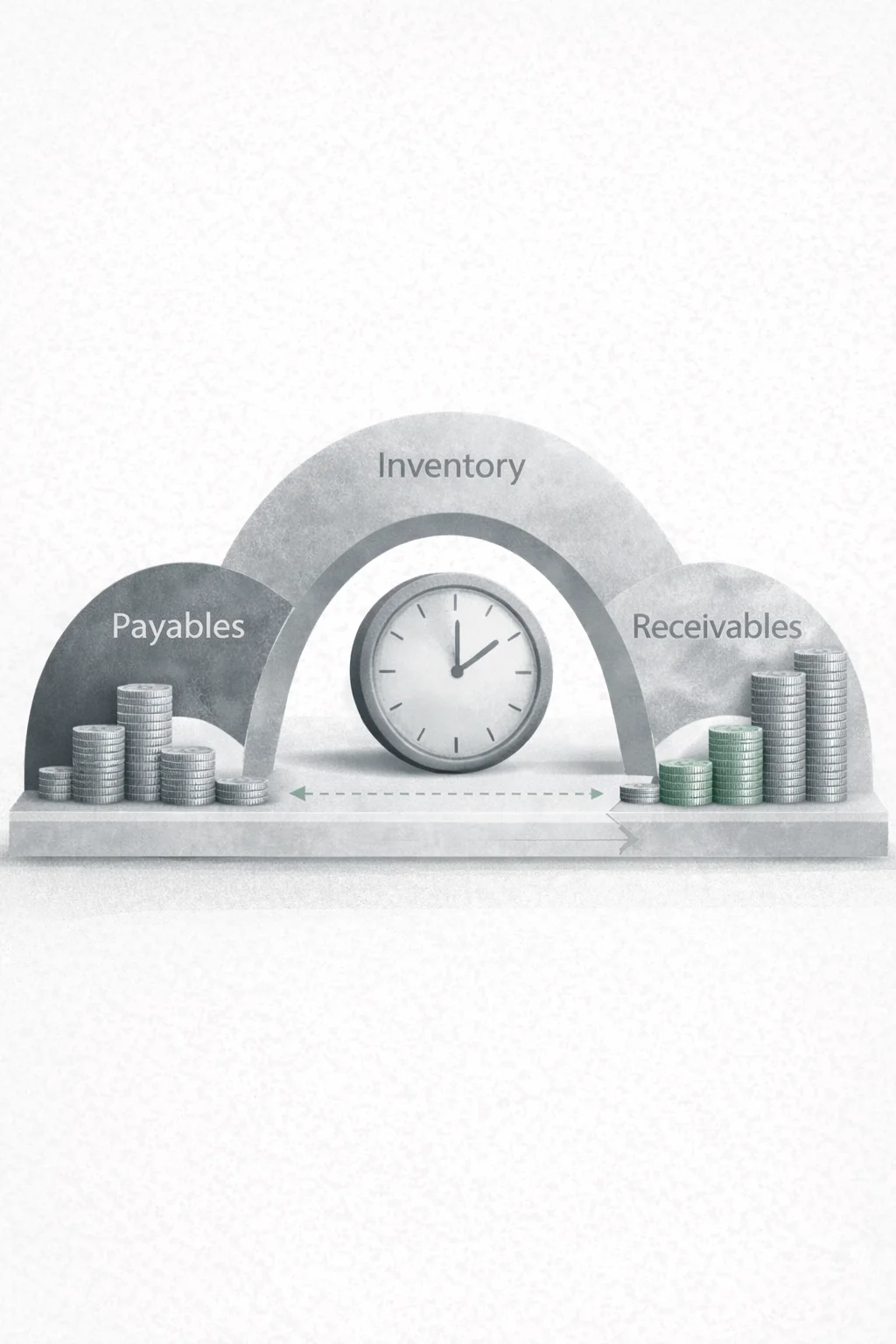
This Knowledge Hub adds another layer to that reality — a CFO (financial) perspective on inventory decisions: how working capital is deployed over time, how quickly it returns, and why that determines whether growth feels smooth or cash-constrained.

These principles also form the design logic behind e-xponetix — a decision engine built to apply them consistently in real inventory planning.

The goal is simple: help you grow not by working harder, but by using the same capital more deliberately.

What this Knowledge Hub is about

This Knowledge Hub explains how inventory, cash flow, and growth decisions work from a CFO perspective — treating inventory as a capital investment constrained by time, cash availability, and return.

It focuses on:

  • inventory decisions as capital allocation decisions
  • margin and turnover evaluated together
  • capital constraints and opportunity cost
  • lead time, payment terms, and settlement cycles as financial variables
  • cash conversion cycle as a time-based measure of capital efficiency
  • replenishment as an optimization problem under constraints

Who This Is For

This material is written for operators who:

  • manage dozens or thousands of SKUs
  • work with multiple suppliers, sales channels, or fulfillment options
  • already track margins and operational metrics
  • have limited cash and want to scale faster using the same working capital

Knowledge Hub Sections

Explore in-depth guides on inventory management, cash flow optimization, and scaling strategies.

Evaluating Inventory as Investments

Evaluating Inventory as Investments

Inventory decisions are often framed operationally: what to restock, how much to order, and when to reorder.

From a financial perspective, these are capital allocation decisions: each replenishment commits limited capital into a specific combination of products, suppliers, channels, fulfillment options, and payment terms — for a certain period of time and with an expected financial outcome.

What this section covers:

  • why inventory replenishment decisions are capital allocation decisions, not operational tasks
  • why margin and inventory turnover must be evaluated together
  • how cost of capital defines whether an inventory decision creates or destroys value

Articles in this section:

Why Cash Timing Shapes Growth

Why Cash Timing Shapes Growth

Commercial success creates volume, but volume alone does not create liquidity.

Lead times, payment terms, and settlement cycles determine capital allocation decisions. Ignoring timing can make profitable operations fragile and slow-growing, even when sales look strong.

What this section covers:

  • how payment terms and settlement cycles shape liquidity
  • why sales and revenue do not equal cash inflow
  • why cash timing is a critical constraint for growth, even in profitable businesses

Articles in this section:

Building Forward Visibility

Building Forward Visibility

Good decisions require visibility into the future.

Demand forecasts, sales forecasts, and cash flow forecasts serve different purposes and support different decisions. Confusing them leads to false confidence, overstocking, missed opportunities, and avoidable cash pressure.

What this section covers:

  • the difference between demand forecasts and sales forecasts
  • why demand, sales, and cash flow forecasts serve different decisions and have different limitations
  • why cash flow forecasting is essential for capital planning and growth

Articles in this section:

  • Demand Forecast vs. Sales Forecast — and the Limitations of Automated Forecasting - coming next
  • Cash Flow Management — Why You Need a Cash Flow Forecast - coming next
When Replenishment Becomes an Optimization Problem

When Replenishment Becomes an Optimization Problem

As assortments grow and constraints multiply, replenishment decisions stop being SKU-by-SKU choices.

It becomes a constrained optimization problem across SKU × supplier × channel × fulfillment combinations under simultaneous constraints — budget, minimum order quantity and volume, supplier stock, inbound limits, demand, capacity, and others.

What this section covers:

  • why replenishment decisions cannot be made independently for each SKU
  • how multiple constraints interact in real inventory decisions
  • why optimal replenishment requires explicit objectives and trade-offs

Articles in this section:

  • Why Inventory Replenishment Is Fundamentally an Optimization Problem - coming next
Case Studies and Real Outcomes

Case Studies and Real Outcomes

This section will gradually include real-world examples showing how applying CFO-level financial thinking to inventory decisions changes outcomes in e-commerce businesses.

The focus is not on isolated tactics, but on how capital allocation, cash timing, and constraint-aware decision-making affect liquidity, risk, and the ability to scale.

What this section covers:

  • how capital can be redeployed into faster-returning products
  • how liquidity can be improved without raising additional funding
  • how cash cycles can be shortened through better inventory decisions
  • how businesses can scale more efficiently under capital constraints

Articles in this section:

  • coming next
Glossary of E-commerce Finance

Glossary of E-commerce Finance

Many of the terms used across inventory, profitability, and investments discussions are familiar, but often interpreted differently in practice.

This glossary defines key e-commerce finance terms as they are used in this Knowledge Hub — from a practical, decision-oriented perspective. Definitions are kept consistent across all articles to ensure that concepts are applied in the same way when making inventory and capital allocation decisions.

How to use this Glossary:

  • each term reflects how it affects capital allocation decisions
  • definitions focus on operational meaning, not accounting theory
  • terms are linked directly from articles where they are applied

If a term is missing or you'd like it explained, you can suggest it for inclusion. Contact Us

Articles in this section:

About Your e-commerce CFO

This Knowledge Hub is written from the vantage point of a CFO who has worked closely with e-commerce operators and marketplace sellers.

You already have commercial expertise. This framework adds the financial layer that helps you scale — not by increasing spend, but by understanding how capital is deployed, how it moves through investment cycles, and how constraints shape real-world decisions.

The perspective throughout this Knowledge Hub is deliberately practical: focused on decision quality, capital efficiency, and long-term financial resilience rather than short-term operational optimisation.

Contact Us

If You Want to Go Further

If these principles resonate and you want to apply them without spreadsheets or manual work, you can explore how they are embedded into the tools we build at e-xponetix.

These tools translate CFO-level financial thinking into day-to-day inventory decisions — helping you allocate capital more deliberately, manage cash flow proactively, and scale without running into liquidity constraints.

The goal is not to replace judgment, but to make this financial logic explicit and repeatable across thousands of decisions.

Learn more about e-xponetix

If you have suggestions for improvement or topics you'd like covered — we'd love to hear from you. Contact Us →

Stay Updated

Subscribe to receive new articles and updates from the Knowledge Hub directly in your inbox.